Earlier this month we (Elizabeth, Eski-the-dog and I) travelled to northern Victoria (Aus) to explore the contexts within which my ancestors made emigration choices (and to visit interesting places). This project is very much a beginning-and the trip helped me identify potential sources for future data collection.

To understand this trip and intention, an explanation is needed. I discovered that I and my Henderson siblings (via my grandfather Claude O’Reilly) have a branch of our family that spent a generation or so in Australia-as part of an intergenerational migration pathway from Ireland to England/Wales, to Australia and then onto New Zealand. This connection with Australia was new to me and has become something that I wish to understand in more detail.
My academic research has largely centred on adult learning choice making. At the centre of that work, I realised and found that learning connected choice making is often not about learning. In my PhD research project, I found that some types of choice making have lifelong significance for the individual and implications for people around the people making the choices. And the choice making often involved travel that had long-term, life-changing consequences (such as emigration to Australia for study-leading to citizenship and ongoing employment).
As a result, I wondered whether I could use the learning choice tracker (LCT) from my earlier work to look at intergenerational choice making-more a Life Choice Tracker (perhaps an LCT2).
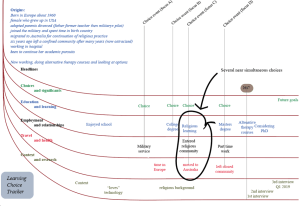
(see Henderson, 2022)
Instead of looking at typically four choice making experiences of an individual, I can reshape that perspective so that I am looking at key emigration connected experiences of four people from different generations.
However-there is a major issue in applying a technique like the LCT in contexts where the people involved are no longer accessible. My research has usually relied on multiple semiformal interviews to develop understanding at an individual level. Those people are no longer available (and nor are their children). I need to develop an understanding of potential aspects (such as the potato famine in Ireland as a ‘push’, and the gold rush in Victoria, Australia and then in New Zealand as ‘pulls’) as well as accounting for the interconnectedness that lived experience provides through family connected traditions and personal experiences of life ‘on the ground’. The approach may be to create simulcrums to take account of those parts that can’t be determined and then merging those perspectives or views with the parts that we can know (through information gleaned from records of births, deaths and marriages or through tools like ancestry.com).
I have tracked down a book that I recall from my childhood-something written by a relative (great aunt) in the 1960s that is an account of the experiences of other relatives from connected family trees. My question, therefore, is how can I use the written experiences, recollections and reflections of others to form a facsimile of the choice making experiences of people undertaking multigenerational emigration journeys? I will let you know how I go.
 Dr Michael J Henderson